

Card Author:
Location:
Date:


Carbognano, Castle wash-house
THE HISTORY
The push to the urban renewal of Carbognano given by Giulio Colonna and his son Francesco Colonna, led to the need to realize the fountains inside and outside the castle. In 1611 in the Municipal Council was discussed the point for the realization of the fountains for washing clothes, coming to the conclusion that for service and public convenience was necessary to realize them making them pay to the Community: “Congregato et Coadunato general council … 3° Item it is proposed that since it is seen that all the people suffer the damage of the inconvenience and inconvenience that they have in washing clothes in these times to provide themselves with water and for this reason it was thought to make the fountains for such service for public convenience in some place convenient to all and for the community. and to make this expense, since there are no denarii, it could be possible to sell some grain, but they will do what they think opportune in this negotiation, letting them know that in Bassanello lime will be sold at 8 bolognini the rubio. Giovanni Zuccaro invocato ….supra la 3 che li fontanili si faccino et per pagare la spesa si facci l’impe(gno) per accio sia prima la Comunità soministri denari”. (ASCC, SAR, August 10, 1611, cc. 72v. 73r.). It took several years to see the work started. Through the book of City Councils and the book of receipts and expenditures of the Chamberlain, it is possible to follow the steps that led to the construction of these “washers. In 1612 the Camerlengo had expenses to pay for the architect who was to follow the work “I spent money to give food to Mastro Domenico Manichini, architect of Bagnaia, who came for the washers together with the Priors who ate with the said architect”. (ASCC, SAR 7b/3, LEUC – 1612). But still in 1613 the works had not been started: “Congregato et Coadunato generali consiglio … Item se fa li sapere ancora qualmente de ordine di Sua Eccellenza Illustrissima si ha da far accomodare la piazza et far anco li lavatori per le donne et questo con giudizio di un architetto il quale è necessario per questo effetto farlo venire acciò possa vedere quel che bisogna et ordinare quello che si sarà da fare. Domenico Propertio Barberio Invocatorum Consiglia … Supra la 3° Che li Suddetti Signori Priori faccino venire un architetto per far desegnare li lavatori et ancò l’assettamento della Piazza”. (ASCC, SAR 2/7, AD – LC, February 10, 1613, cc. 141r – 141v. ). The traces of payments for the architect and the masons testify to the start of the work in June of the same year: “I gave to the architect who came for the square and for the washer”, “I gave to Mastro Giovanni de Caprarola for half a day that he worked in the square for the washers”. (ASCC, SAR 7b/3, LEUC – 1613). In 1615 it was very likely that another wash-house outside the castle, under the church of Santa Maria, was also conceived, given that the work on the wash houses in the castle had been started: “Congregato et Coadunato generali Consiglio … 1° It is proposed and made known to the Holy Father that other times it has been proposed to want to make for public service a wash house for the women, seeing and knowing that it suffers so much, however, it is proposed that they decide whether they want to make it or not and how it will be paid for. Magistro Domenico invocatorum circa la prima consilia che li Signori Priori per fare il lavatoio per servizio publico si facci venire un architetto acciò si faccia in luogo più comodo al publico et di manco spaesa che sia possibile et dove giudicarà detto architetto si faccia detto lavatoio”. (ASCC, SAR 2/7, AD – LC, February 7, 1615, cc 91r. 92r.). Two months later a contract was stipulated between the Community and Mastro Pietro Scalpellino and mason to build the ducts and the wash-house beyond the ditch: “Magistro Pietro mason and stonemason in Carbognano with the presence of the Illustrissimo et eccellentissimo Signor Fausto Nofrij deputed by His Illustrious Excellency and of Signor Fabritio Petitti spontaneously promises to the Priors … to make the conduit and vase of the washers to serve the women of the ditch where the place has been destined and to do so in accordance with the design of Paulo Maggi, Architect”. (ASCC, SAR 2/8, AD – LC, March 14, 1615, cc 93v. 94v.). Again in 1616 the Camerlengo noted other expenses regarding the work of the washers: “I have given the past few days to Mastro Benedetto Passo de Bassanello for a good account of the ducts he has to make for the washers”.
“fervid work for the washers”. (ASCC, SAR 7b/3, LEUC – 1616). As we have seen, various architects were involved in the realization of the various wash-houses, as well as various masons and stonemasons, most likely to allow the work to proceed in parallel and simultaneously. In the following years our sources do not bring us any more important information regarding the works on the wash-houses. From 1623 we find mention of an intervention for “rassettae (accomodare) i lavatori” and from then on only similar references for the tub or the ducts. Therefore, we can affirm that in a lapse of time between 1615 and 1616 the wash-house of the castle and the other wash-houses of Santa Maria and the one of the valley were realized.
DESCRIPTION
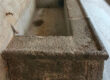
The wash-house is located at the base of the castle, next to the retaining wall of the garden of access to the kitchens. Placed inside a covered structure, characterized in the main facade by five large pillars that support the roofing tiles. The actual wash-house has a long basin obtained in leucitic stone with an ellipsoid shape divided into three sectors. All the edge of the large basin has the inclined plane to allow the procedure of the washing of the cloths of rubbing and wringing. Three steps descend to the floor of the wash-house, skirting a stretch of the water pipe left uncovered that brings water into the tub. A large stone is situated at the mouth of the channel. On the back wall of the covered room there is a coat of arms that shows a column and a rampant lion, emblem of Francesco Colonna who promoted the realization of the work with the economic support of the Community of Carbognano. A large seat runs along the whole wall. The structure allowed the women of the village to go and wash their clothes indoors in any weather condition. The shape of the wash-house allowed a large number of places to wash at the same time, taking advantage of the different tanks depending on the phase of the washing. One was used for the first rinsing of the clothes from the lye (ancient compound of ash and water, which cooked with animal fat gave rise to the first soaps), and the others for the final washing.
ESSENTIAL BIBLIOGRAPHY
E. ABBATE, Guide to the province of Rome – volumes I and II, edited by the Italian Alpine Club, 1894.
V. ARAMINI, Sicut Archivium inventum fuit”. The Ecclesiastical Archives of Carbognano (Viterbo). Nuovo ordinamento ed inventariazione infomatizzata. Thesis, Faculty of the University of Tuscia, Viterbo, Academic Year 2005/2006.
R. CECCARELLI – O. TARTARINI, Carbognano, yesterday, today and tomorrow. 1940.
V. D’ARCANGELI, Carbognano in Tuscia Viterbese. Rome 1968. R. INNOCENTI, Carbognano. Viterbo 2001.
F. MARTINELLI, Carbognano illustrated by Mr. Fioravante Martinelli. Rome, 1694.
G. SILVESTRELLI, Cities and castles and lands of the Roman region. Rome, 1940.
Unpublished sources
Historical Archives of Carbognano, Ancient Regime Series 2/7; 2/8; Deliberative Acts – Council Books. = ASCC, SAR, AD – LC Archivio Storico Comunale di Carbognano, Serie Antico Regime, 7b/2; 7b/3; Libro delle Entrate e delle Uscite del Camerlengo. = ASCC, SAR, LEUC