

Card Author:
Location:
Date:


Carbognano, Fountain of Santa Maria
THE HISTORY
The fountain of Santa Maria was born in the context of urban redevelopment wanted by Lavina Della Rovere Orsini, who took over the management of the castle from 1573 until the year of his death (Rome, July 26, 1601). In this period were made works aimed at the reorganization of churches, the construction of roads inside and outside the village and especially was given space to places of civic use such as squares and fountains. It is in this perspective that in the district of Santa Maria, the new fountain, in addition to providing better decoration of the square in front of the church of the same name, could serve a part of the population located in the part of the village that led to the road to Fabrica di Roma. From the town councils we know that on February 13, 1583 the realization of the fountain had already begun, but the lack of money did not make possible the end of the works. In the same council in order to fill this lack the solution was given to use some money that the same Community had to collect from Fratino De Cesaris Frazzino: “It is proposed… secunda is begun the fountain and the brickwork of Santa Maria and in the one in the other if it ends, if some date is not imposed, some other party. … supra la secunda it is not time to throw a date, now to the poor men but that there are/ c. 117r./ but that there are deniers to be collected and especially the deniers that are paid to Fratino that is 69 scudi and others as in the books, and that are collected to do what is necessary. 1° fratinoDe Cesaris Frazzino (ref.to c. 119v) April 3, 1583”.(ASCC, SAR 2/3 Atti Deliberativi – Lib. Cons. , February 13, 1583, cc. 116r. – 117r.). Shortly afterwards the fountain was completed, satisfying the needs of the population. A few decades later (1616), we find again at the center of the scene the fountain of Santa Maria when it became necessary to interrupt the flow of water in order to allow renovation works to the houses of the district that threatened ruin: “Messer Giovanni Picciolotti who is here in Carbognano has seen the foundations that are missing from the houses of the castle at the fountain of Santa Maria and he wants to accommodate/redirect the water of that fountain in the square for public service and he wants to do all the expenses for the Community…” (ASCC, cc. 116r 117r). …”.(ASCC, SAR 2/8, Acts of Deliberation – Council Books, October 28, 1616, cc. 118v. 119v.). In 1628, it is still witnessed thanks to the City Councils another intervention on the fountain, defining in the proposal made in the council, the action useful to the public: “it is proposed to SS. Vostre as it has been thought to make the road of Santa Maria alli Pagliaricci and other places of necessity suitable for the public and to make the fountain suitable as well, which needs to do this is to buy some lime, but they will decide if they want to buy it or not. “It was confirmed the intervention in the same council, “that we proceed with the lime to fix the road and other places of need (the fountain), and we will provide everything that is needed”. (ASCC, SAR 2/11, Acts of Deliberation – Books of Councils, February 6, 1628, cc. 155v – 156r. ). So it was the community that provided for the maintenance of this and all other sources of the village, aspect clearly visible through the small epigraph on the facade of the fountain where it appears together with the symbol of the Municipality of Carbognano (three ears of corn inserted in the crowned coat of arms), the date A.. D. MDCCCLII, in memory of another of the interventions made at the expense of the Community of Carbognano. Still today, after four centuries of life, the communal fountain of Santa Maria is placed to decorate the square and is in perfect working order.
DESCRIPTION
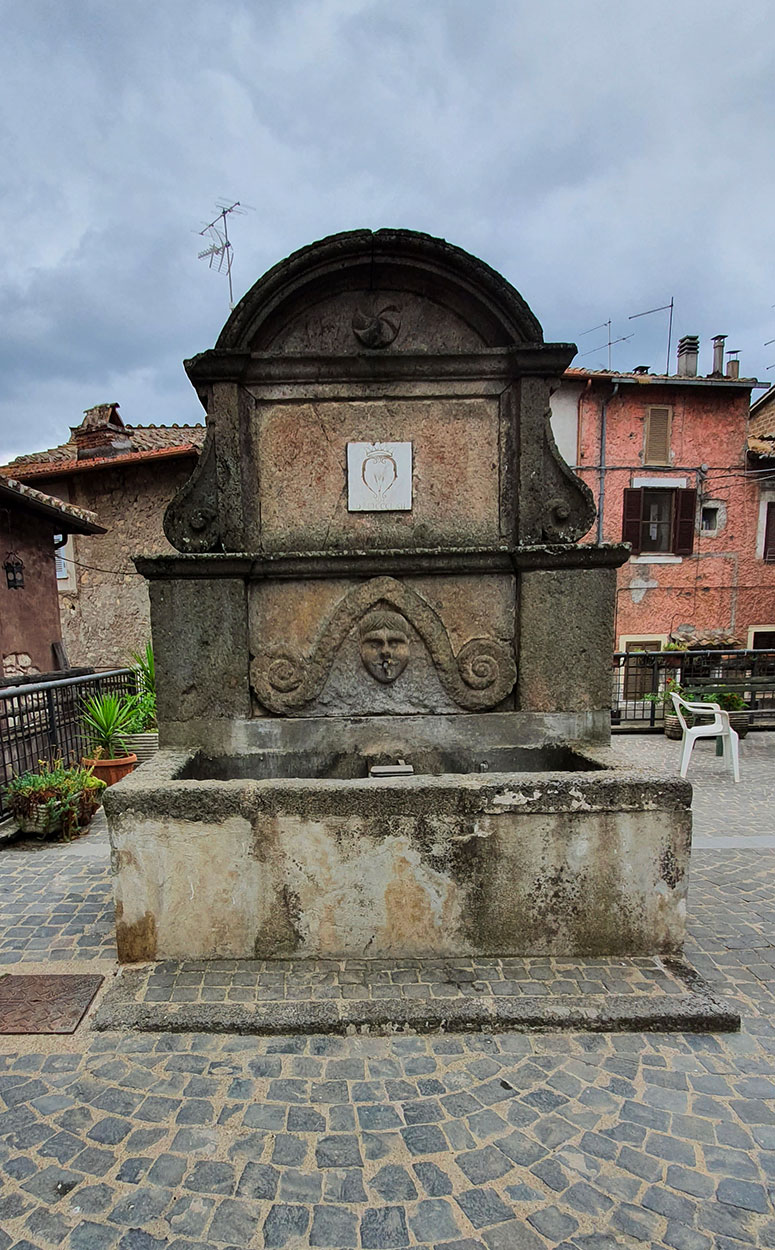
The fountain presents itself in its simple frontal elevation characterized by a single rectangular basin resting on a composite wall closed at the top by an arched tympanum. Only some parts of the frontal decoration are plastered, while the rest is characterized by the typical Viterbo peperino stone. Immediately above the rectangular basin is placed as a decoration a protome of a male face from whose mouth comes out the only straw of the fountain. Above the face a ribbon forms a pointed arch, closed at the sides symmetrically by volute terminations. In the upper order the wall is presented with the space completely empty, enriched by a small marble slab that shows engraved the coat of arms of the Municipality of Carbognano (3 ears of corn and the crowned coat of arms), and the date: A.. D. MDCCCLII, to refer to one of the restoration interventions made by the Community. The decoration ends at the top of a lunette, inside of which there is a clipeus with 5 radial curvilinear flaps that start from the center and open towards the outside.
A curiosity: inside the castle, in the main hall, above the large window, there is a roundel with the representation of a unicorn drinking in the fountain of Santa Maria.
ESSENTIAL BIBLIOGRAPHY
E. ABBATE, Guide to the province of Rome – volumes I and II, edited by the Italian Alpine Club, 1894.
V. ARAMINI, Sicut Archivium inventum fuit”. The Ecclesiastical Archives of Carbognano (Viterbo). Nuovo ordinamento ed inventariazione infomatizzata. Thesis, Faculty of the University of Tuscia, Viterbo, Academic Year 2005/2006.
R. CECCARELLI – O. TARTARINI, Carbognano, yesterday, today and tomorrow. 1940.
V. D’ARCANGELI, Carbognano in Tuscia Viterbese. Rome 1968.
R. INNOCENTI, Carbognano. Viterbo 2001. F. MARTINELLI, Carbognano illustrated by Mr. Fioravante Martinelli. Rome, 1694.
G. SILVESTRELLI, Cities and castles and lands of the Roman region. Rome, 1940.
Unpublished Sources
Historical Archives of Carbognano, Ancient Regime Series = ASCC, SAR Deliberative Acts – Lib. Cons. SAR 2/3; 2/8: 2/11;