

Card Author:
Location:
Date:




Carbognano, Church of Sant’Anna
THE HISTORY
As reported in the memoirs of Don Pietro Totonelli (C – APCSP, p. 390), the church was built at the end of the XVII century, and exactly we find reported: “From the file that is in the archives (for) intercalated controversy between the rector of the church of sant’Anna and the parish priests of Carbognano, year 1795 we read: “the venerable church of Saint Anna was built in 1696 with the pious donations of particular benefactors, particularly Mr. Anterio Carosi and Mr. Angelo Lucianelli, but not at the expense of the Community, which, after having judged the only purpose for which the church was to be built, did not acquire any patronage”.
The place chosen by the community was in the outermost part of the village, along the road leading to Fabrica di Roma and Vallerano. The choice of the benefactors corresponded to a testimony of the ardent and fervent faith that the people of Carbognano had always had for S. Anna. The development of the village in this direction and the increase of the inhabitants made necessary the construction of the new building in order to give the faithful new religious spaces in that area of the village. The church today gives us back the needs of a noble public, Cher had splendid altars built in the baroque fashion of those times. Already in the twentieth century (1913), the building was restored, thanks to the intervention of. Giovannina Mariani in Lazzari, as it is mentioned in the epigraph still present in situ in the corridor that gives access to the sacristy:
““ALLA SACRA MEMORIA DI/ GIOVANNINA MARIANI IN LAZZARI/ RIGIDA NEL SUO DOVERE DI SPOSA E MADRE/ ESEMPLARE PIETOSA NELLE ALTRUI SVENTURE CHE NELL’ANNO 1913/ VOLLE RESTAURATA QUESTA CHIESA/OVE RIPOSA LA SALMA DEL SUO FRATELLINO MARIO”.
Unfortunately, in the ’70s of 1900 the church was the target of looting and were stolen the original paintings that decorated the altars. At that time the church was pillaged and the original paintings that decorated the altars were stolen. In 2005 an intervention of restoration allowed to totally restore the roof and the external walls of the church, bringing the building back to its ancient splendor.
THE EXTERIOR
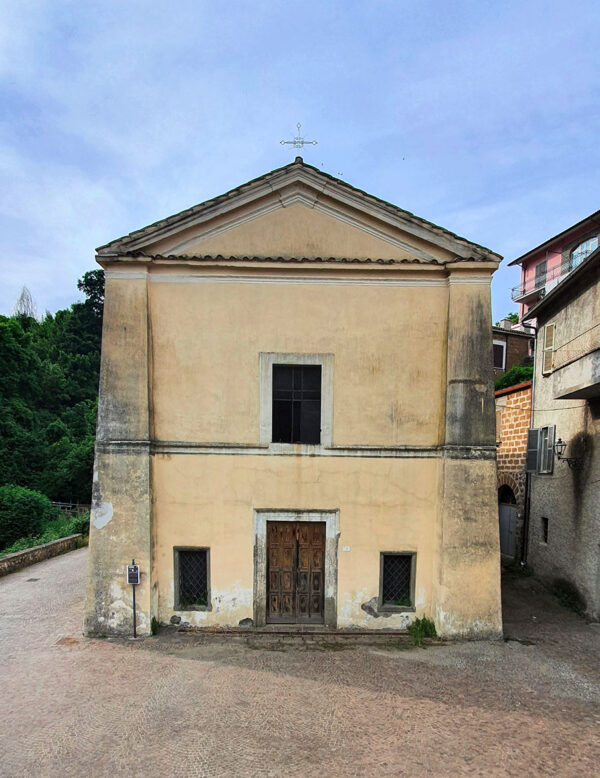
The facade is marked by two superimposed orders. In the first one, the central portal with a simple trilithic structure, at the sides of which two large windows with grating allow the light to enter inside. In the second order, marked by a frame, there is a single large rectangular window placed in a central position. At the top of the structure there is a tympanum decorated with simple moldings.
At the sides of the facade stand out two imposing buttresses, made to contain the vertical thrusts given by the enormous weight of the high walls of the structure. The bell tower with a rectangular base placed at the bottom of the structure on the left is intact and with the bell still in situ.
THE INTERIOR
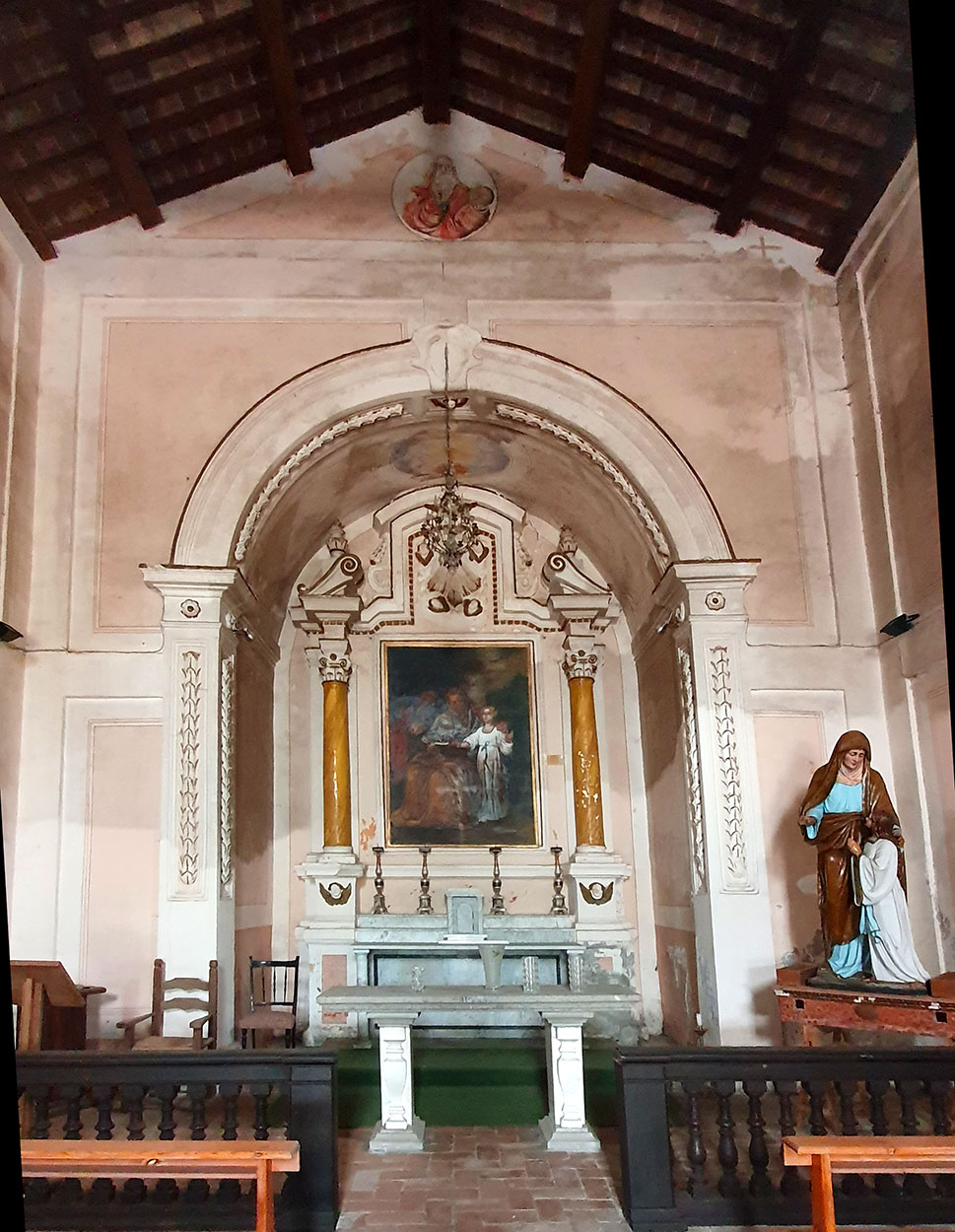
The interior has a large single nave with a trussed roof. In the side walls there are two chapels and their altars. The first on the left has a canvas depicting Saint Anne, the Virgin and the Child. The second on the right has a canvas with the Rest during the flight into Egypt. As witnessed by the pastoral visits still in the middle of the nineteenth century, the altars were respectively entitled: the high altar to St. Anne, the one on the left wall to St. Francesca Romana and the one on the right to St. Gregory the Great (ADCC, Series pastoral visits, Visit Mengacci, 1860 – 1866, cc. 8r/v). On the high altar, richly decorated with baroque stuccoes, there is a canvas depicting S.. Anna, S. Giacchino and the little Maria. The paintings are no longer the original ones, stolen in the ’70s of the twentieth
The paintings are no longer the original ones, stolen in the ’70s of the twentieth century, but have been repainted in the likeness of the original ones.
Through a door located to the left of the presbytery, decorated with moldings and tympanum, in which a cherub in stucco is placed among triglyphs, one enters the corridor that leads to the sacristy. The small environment of the sacristy has a splendid barrel vault with all the moldings still present all the moldings. In the back wall a small niche still survives. The church of sant’Anna, lacking of an in-depth study, is proposed as a beautiful testimony of the local baroque, even if it is deprived of many looted works. The many stuccoes decorated with gold leaf present in the church are an excellent field to investigate for future specific studies.
ESSENTIAL BIBLIOGRAPHY
V. ARAMINI, Sicut Archivium inventum fuit”. The Ecclesiastical Archives of Carbognano
(Viterbo). Nuovo ordinamento ed inventariazione infomatizzata. Degree Thesis, Faculty
University of Tuscia, Viterbo, Academic Year 2005/2006.
R. CECCARELLI – O. TARTARINI, Carbognano, yesterday, today and tomorrow. 1940.
V. D’ARCANGELI, Carbognano in Tuscia Viterbese. Rome 1968.
R. INNOCENTI, Carbognano. Viterbo 2001.
F. MARTINELLI, Carbognano illustrated by Mr. Fioravante Martinelli. Rome, 1694.
M. R. MECHELLI- G.PESCIAROLIi- R. ROSSETTI, Carbognano churches of S. Peter and S. Anna. Repertoire of Paintings on Canvas. A.A. 1993/1994. 3° A State Middle School of
Carbognano.
G. SILVESTRELLI, Cities and castles and lands of the Roman region. Rome, 1940
Unpublished sources
ADCC, Series pastoral visits, Mengacci Visit, 1860 – 1866, cc. 8r/v.
C-APCSP = Carbognano, Archivio Parrocchiale della Collegiata di san Pietro. Memorie di questa Ven. le chiesa Collegiata di San Pietro della Terra di Carbognano dall’epoca della sua fondazione in poi. Regole di vari luoghi Pii”. Memorie scritte da don Pietro Totonelli.